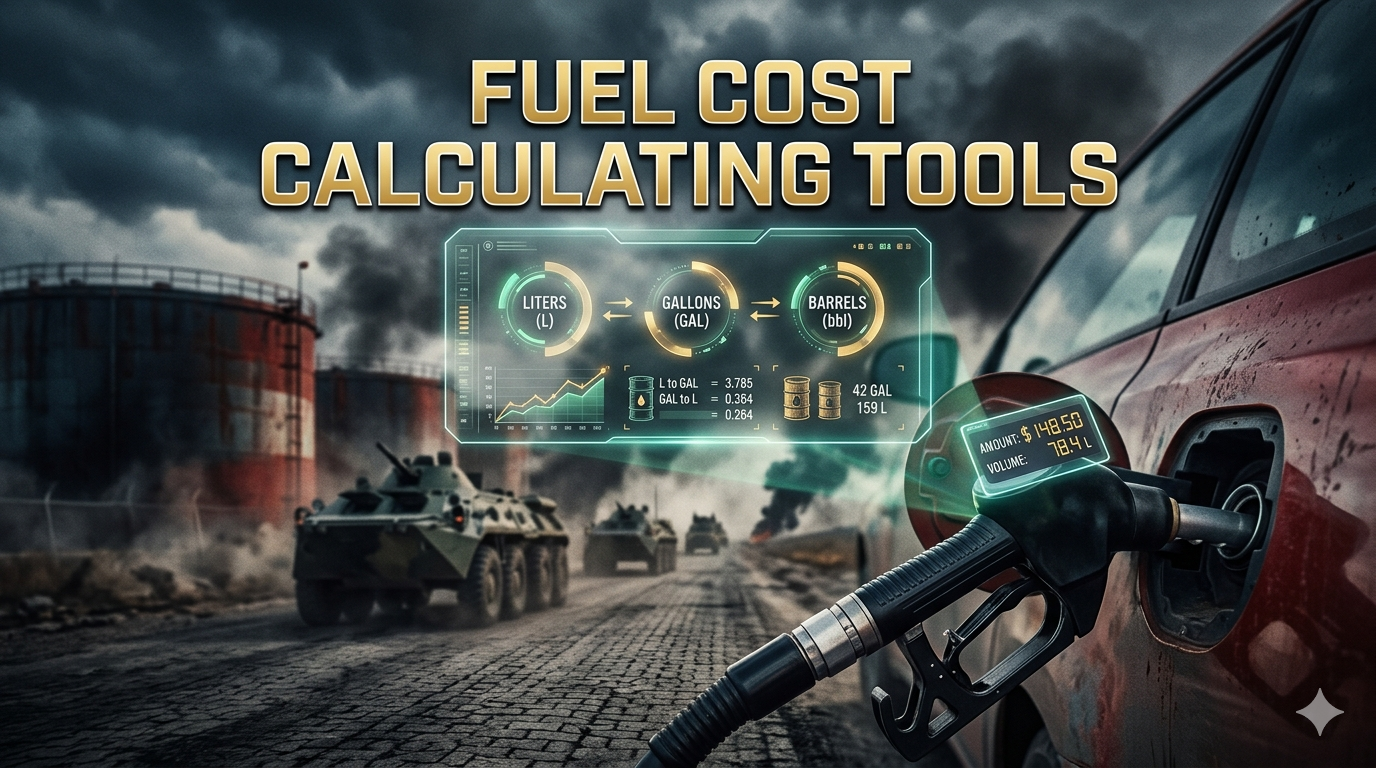
Managing travel expenses and household budgets has become a significant challenge for many families and businesses lately. If you have been to the gas station recently, you’ve likely noticed that the numbers on the pump are climbing faster than they used to. Whether you are a daily commuter, a small business owner, or someone planning a road trip, understanding the mechanics behind fuel price hikes is the first step toward managing your costs effectively.
This article explores why fuel prices fluctuate, the global factors at play in 2026, and how you can use simple conversion tools to keep your spending in check.
Fuel Prices Rising in Wars, But Why?
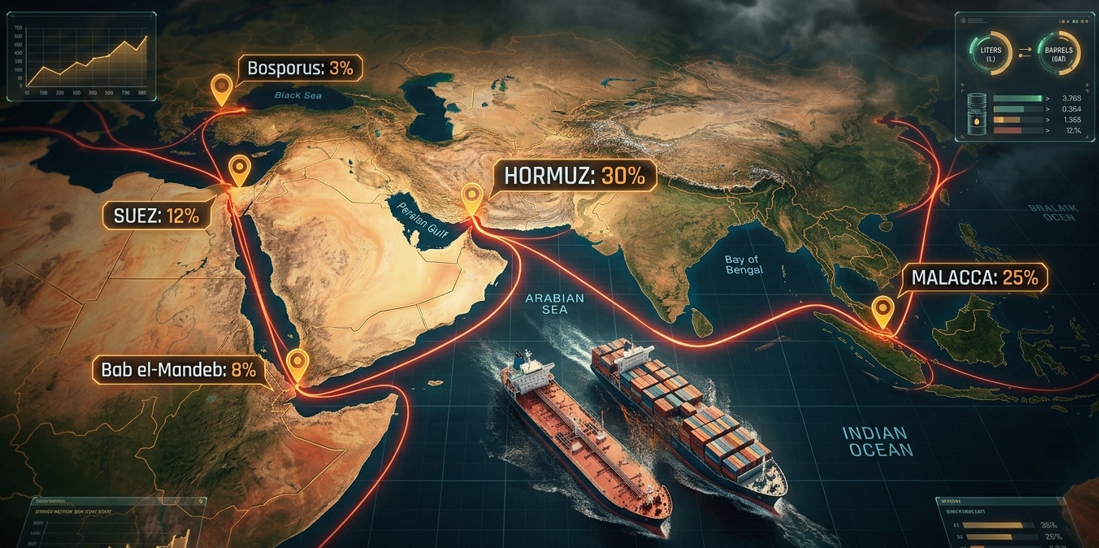
The world’s oil supply relies on a few remarkably narrow choke points. When war or tension hits these specific strips of water, the percentage of global trade at risk is staggering. Here is the detail table of explaining these choke points percentages:
|
Strait / Canal |
% of Global Oil Trade (Approx.) |
Daily Volume (Barrels) |
Key Impact |
|
Strait of Hormuz |
20% – 30% |
~21 Million |
The world's artery connects Middle East producers to the global market. |
|
Strait of Malacca |
20% – 25% |
~15 Million |
The primary gateway for oil flowing to China, Japan, and South Korea. |
|
Suez Canal / SUMED |
10% – 12% |
~9 Million |
The shortest link between the Atlantic and Indian Oceans; vital for Europe. |
|
Bab el-Mandeb |
8% – 10% |
~8 Million |
The entrance to the Red Sea; highly vulnerable to regional instability. |
|
Danish Straits |
3% – 5% |
~3 Million |
Primary exit for Russian oil exports to Europe. |
1. Increased Military Consumption
War is an incredibly energy-intensive activity. A single modern tank can get less than 0.6 miles per gallon (0.25 km/L). When a military mobilizes, its demand for JP-8 (Jet Fuel) and Diesel spikes to massive levels. This sudden surge in "government demand" competes with "civilian demand," leaving less fuel available for regular commuters and businesses.
2. Weaponization of Energy
In some conflicts, energy is used as a "geopolitical lever." A country may intentionally slow down its exports to create economic pressure on the allies of its enemy. By restricting the flow of Natural Gas or Crude Oil, they can cause "energy inflation" in foreign nations, hoping to weaken their political resolve.
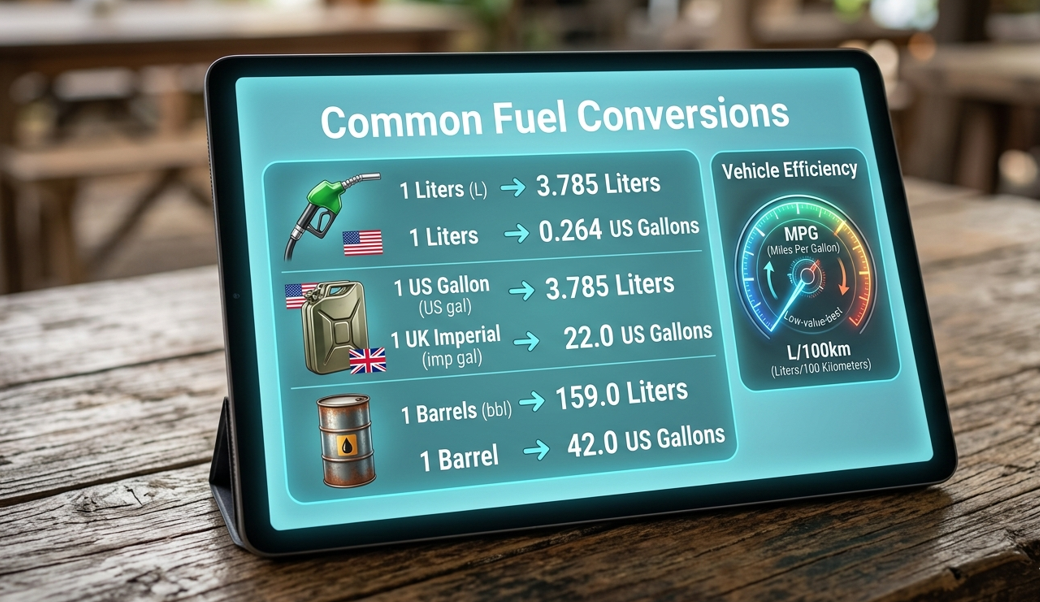
Common Fuel Conversions
On AllFileTools, we provide the conversion logic to help you make sense of these numbers.
1. Liters vs. Gallons
While the world is largely metric, the "Gallon" still dominates in several major markets. However, the size of that gallon depends entirely on which side of the ocean you are on.
- Liters (L): The standard metric unit used globally. Most fuel pumps outside the US and UK will display prices and volume in Liters.
- US Gallon (US gal): Used in the United States and many Latin American countries.
- 1 US Gallon = 3.7854 Liters
- UK Imperial Gallon (imp gal): Used historically in the United Kingdom and some Commonwealth nations. It is significantly larger than the US version.
- 1 UK Gallon = 4.5461 Liters
- The Conversion Secret: A UK Gallon is approximately 20% larger than a US Gallon. If you use a US calculator for a UK vehicle, your efficiency numbers will be completely wrong.
2. Barrel (bbl) vs Gallons vs Liters
In the news, you will often hear that "Oil is trading at $120 per barrel." But how much fuel is actually in a barrel? In the oil industry, a "Standard Barrel" is a specific unit of measure.
- 1 Barrel = 42 US Gallons
- 1 Barrel = approx 159 Liters
- 1 Barrel = approx 35 UK Gallons
3. Efficiency Metrics: MPG vs. L/100km
There are two primary ways the world measures how thirsty a car is. One measures distance per unit, the other measures fuel per distance.
- MPG (Miles per Gallon): Common in the US and UK. A higher number is better (it means you can go further on less fuel).
- Note: Because UK gallons are bigger, a car rated at 40 MPG in the UK would only be rated at about 33 MPG in the US.
- L/100km (Liters per 100 Kilometers): The standard in Europe, Canada, and Australia. A lower number is better here (it means you need fewer liters to cover the distance).
- Km/L (Kilometers per Liter): Frequently used in South Asia and South America. It tells you exactly how many kilometers you get for every liter of petrol or diesel.
4. Quick Reference Conversion Table
For a fast mental calculation or when setting up your AllFileTools converter, use these "Golden Ratios":
|
From Unit |
To Unit |
Multiply By |
|
US Gallons |
Liters |
3.785 |
|
UK Gallons |
Liters |
4.546 |
|
Liters |
US Gallons |
0.264 |
|
Liters |
UK Gallons |
0.220 |
|
Barrels (Oil) |
US Gallons |
42.0 |
|
Barrels (Oil) |
Liters |
158.98 |
5. Fuel Cost per Unit
The most vital number for any commuter is the Fuel Cost per Mile or Fuel Cost per Kilometer. To find this, you simply take the current price at the pump and divide it by your vehicle’s efficiency.
Total Cost = (Distance / 100) × (L/100km) × (Price per Liter)
How to use this formula:
- Distance: Enter the total kilometers of your trip.
- L/100km: Enter your vehicle's fuel consumption rating.
- Price per Liter: Enter the current cost of fuel at the pump.
Example Calculation: If you are traveling 500 km, your car uses 8 liters per 100km, and fuel costs $1.50 per liter:
- (500 ÷ 100) = 5
- 5 × 8 = 40 liters total
- 40 × $1.50 = $60.00 Total Cost
By mastering these units, you can accurately compare fuel costs whether you are looking at a crude oil report from Dubai, a car review from London, or a gas station sign in Texas.
Quick Tip for AllFileTools Users
If your vehicle uses MPG (Miles per Gallon) instead of L/100km, remember to use our Unit Converter first to get the metric value before applying this formula!
Why Use AllFileTools for Fuel Calculations?
At AllFileTools, we understand that data is only useful if it’s accessible. Our suite of conversion tools is designed to help you navigate these economic changes with ease.
- Accuracy: Our algorithms are updated to handle the precision required for scientific and professional logistics calculations.
- Speed: In a world where fuel prices change in an instant, our tools provide results in milliseconds.
- Accessibility: Whether you are on a desktop in an office or a smartphone at a gas station, our site is fully responsive.
The Economic Ripple Effect
High fuel prices do more than just make driving expensive. They impact the price of almost everything else.
- Food Prices: Most of our groceries are transported via diesel-powered trucks. When diesel prices rise, the cost of moving that food is passed on to the consumer at the supermarket.
- Public Transport: Buses and trains often have to raise fares to cover their increased operating costs.
- Aviation: Airlines are highly sensitive to "Jet A1" fuel prices. A spike in oil usually leads to a "fuel surcharge" on your vacation tickets.
Ways To Save The Fuel Cost
While you can't control global oil markets, you can control your own consumption.
- Check Your Tire Pressure: Under-inflated tires create more drag, meaning your engine has to work harder and burn more fuel.
- Monitor Your Speed: Most vehicles are most fuel-efficient between 50-60 mph (80-97 km/h). Driving faster significantly increases fuel consumption due to wind resistance.
- Use Conversion Tools: Use tools like those on AllFileTools to compare prices if you live near a border or are traveling internationally. Sometimes, driving ten minutes further to a station with a different pricing structure can save you 10% on a full tank.
Conclusion
The hike in fuel prices in 2026 is a reminder of how interconnected our world has become. By understanding the units from liters to gallons and keeping an eye on the factors driving these changes, you can better navigate the economic landscape. Stay informed, use the right tools for your calculations, and keep your vehicle maintained to ensure you are getting the most mile for your money.
Pro Tip: For all your unit conversion needs from volume to weight—visit the dedicated tools section at AllFileTools to simplify your calculations instantly.
Leave a Comment
No comments yet. Be the first to comment!