CSV Diff Tool Find Differences Between Two CSV Files Quickly

Characters: 0
Characters: 0
Comparison Options
Delimiter
Comparison Rules

About CSV Diff Tool

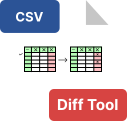
The CSV Diff Tool allows you to compare two CSV files side by side and instantly detect differences between them. It analyzes both files row by row, identifies added, removed, modified, and unchanged rows, and presents the results in a clear and structured format.

This tool is designed for developers, data analysts, QA testers, and anyone who needs to validate or compare CSV data efficiently.

What Is a CSV File?

CSV stands for Comma-Separated Values. It is a simple text-based file format used to store tabular data.

Each line in a CSV file represents a row, and each value within the row is separated by a delimiter (commonly a comma).

Example: 

name,age,city

John,30,New York

Alice,25,London

CSV files are widely used for:

  • Exporting data from databases

  • Spreadsheet applications like Excel

  • Data migration

  • Reporting and analytics

  • Data exchange between systems

What Is This CSV Diff Tool?

This tool compares two CSV contents:

  • Old CSV (Before Update)

  • New CSV (After Update)

It processes both files and categorizes rows into:

  • Added rows

  • Removed rows

  • Modified rows

  • Unchanged rows

The comparison is done using a key column (default: first column) to match corresponding rows.

Why Compare CSV Files?

Comparing CSV files is important when:

  • Validating updated data

  • Checking database export differences

  • Verifying report changes

  • Auditing data updates

  • Tracking modifications between versions

This tool makes it easy to see exactly what changed between two datasets.

Key Features of This CSV Diff Tool

The following features are implemented directly in the tool’s code:

Side-by-Side CSV Input

  • Two separate input panels for Old and New CSV.

  • Large editable text areas.

  • Monospace font for better readability.

Row Classification

The tool detects:

  • Added Rows – Present only in the new CSV.

  • Removed Rows – Present only in the old CSV.

  • Modified Rows – Same key exists but column values changed.

  • Unchanged Rows – Same key and identical values.

Column-Level Change Detection

For modified rows, the tool:

  • Identifies which column changed

  • Displays old value → new value

  • Shows column name (from header row)

Custom Delimiter Support

Users can choose:

  • Comma (,)

  • Semicolon (;)

  • Tab

  • Pipe (|)

  • Space

The selected delimiter is used for parsing both CSV files.

Ignore Case Option

If enabled:

  • Text comparison ignores uppercase and lowercase differences.

Example: 

John = john

Ignore Whitespace Option

If enabled:

  • Leading and trailing spaces are ignored during comparison.

Example:

"John " = "John"

Automatic Empty Row Removal

The tool removes rows that contain only empty or whitespace values before comparison.

Duplicate Key Handling

If duplicate keys exist:

  • The tool automatically appends _dup_1, _dup_2, etc.

  • Ensures unique row matching.

Line Number Display

Each difference shows:

  • Line number reference

  • Key value

  • Row content

Summary Statistics

The Summary tab displays:

  • Old CSV total rows

  • New CSV total rows

  • Added rows count

  • Removed rows count

  • Modified rows count

  • Unchanged rows count

How This Tool Works

The comparison process follows these steps:

Step 1: Parse CSV Files

Both CSV contents are parsed using the selected delimiter.

Step 2: Extract Headers

The first row is treated as the header row.
Headers are used to label column changes.

Step 3: Normalize Values (Optional)

If enabled:

  • Whitespace is trimmed

  • Case is converted to lowercase
    This ensures flexible comparison.

Step 4: Convert Rows to Dictionary

Rows are stored using the key column (default first column) as identifier.

Step 5: Compare Keys

The tool:

  • Finds keys present only in new CSV → Added

  • Finds keys present only in old CSV → Removed

  • Finds keys present in both → Compared column-by-column

Step 6: Detect Column Differences

For shared keys:

  • Each column value is compared

  • Differences are recorded with column name and old/new values

Step 7: Generate Results

Results are structured into:

  • Differences tab

  • Summary tab

Types of Differences Explained

➤ Added Rows

Rows that exist only in the new CSV file.

➤ Removed Rows

Rows that exist only in the old CSV file.

➤ Modified Rows

Rows with the same key but at least one column value changed.

Each modified row shows:

  • Column name

  • Old value (strikethrough)

  • New value

➤ Unchanged Rows

Rows with identical values in both CSV files.

Comparison Options Explained

Delimiter Selection

Controls how columns are separated when parsing CSV files.

Ignore Case

Ignores uppercase/lowercase differences.

Ignore Whitespace

Ignores leading and trailing spaces during comparison.

Results Interface

The tool includes:

Differences Tab

  • Displays grouped differences (Added, Removed, Modified).

  • Scrollable result container.

  • Clear visual color coding:

    • Green → Added

    • Red → Removed

    • Yellow → Modified

Summary Tab

  • Displays numerical statistics.

  • Shows total changes detected.

  • Indicates if files are identical.

User Interface Features

  • Character counters for both CSV inputs.

  • Compare button with loading indicator.

  • Clear All button to reset tool.

  • Tab-based result navigation.

  • Error handling with inline error messages.

  • Toast notification for quick errors.

  • Responsive design for different screen sizes.

  • Light theme support.

Data Handling & Validation

The tool includes:

  • Validation for empty CSV inputs.

  • CSV parsing error detection.

  • Graceful error reporting.

  • Safe HTML escaping to prevent injection.

  • No modification of original CSV content.

Who Can Use This Tool?

This tool is suitable for:

  • Developers

  • QA engineers

  • Data analysts

  • Database administrators

  • Students working with CSV datasets

  • Anyone comparing CSV file versions

The CSV Diff Tool provides a structured and efficient way to compare two CSV files. It detects added, removed, modified, and unchanged rows, supports custom delimiters, and allows flexible comparison options such as ignoring case and whitespace.

With detailed row-level and column-level difference detection, summary statistics, and a clean interface, this tool simplifies CSV comparison and makes data validation easier and faster.

CSV Diff Tool FAQs

Frequently asked questions about using the CSV Diff Tool.

The tool uses the first column (index 0) as the key column to match rows between the old and new CSV files. If two rows have the same value in the first column, they are compared against each other.

If the key column is missing or empty for a row, the tool automatically assigns a generated key based on the row number.

If duplicate key values are found in the same file, the tool automatically modifies the key by appending a suffix such as:

originalKey_dup_1

originalKey_dup_2

This ensures that each row is uniquely identified during comparison.

If one row contains fewer columns than expected, the tool automatically pads missing columns with empty values before comparison. This allows consistent column-by-column matching even when structures slightly differ.

The tool compares normalized values when comparison options are enabled.

  • If "Ignore Case" is checked → values are converted to lowercase before comparison.

  • If "Ignore Whitespace" is checked → leading and trailing spaces are removed before comparison.

However, the original values are still displayed in the results.

No. Unchanged rows are counted and included in the Summary section, but they are not rendered inside the Differences tab unless there are changes.


Yes. If both CSV fields contain data and results already exist, changing options like delimiter or comparison rules automatically triggers a new comparison.