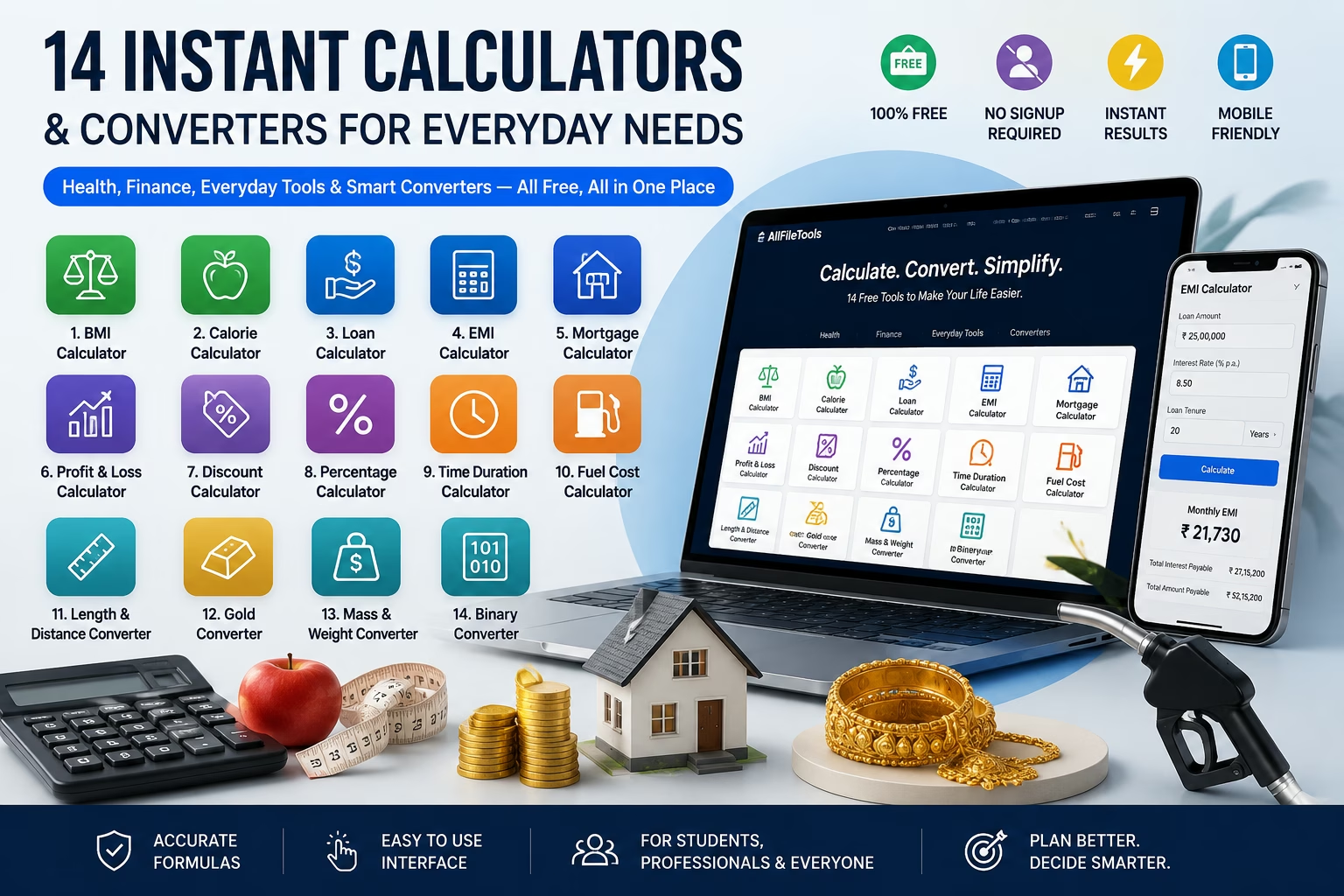
You know that feeling when you're trying to plan a home loan, check your calorie intake, and convert kilograms to pounds — all on the same afternoon — and you end up juggling five different websites, each one slower and more cluttered than the last?
That's exactly the problem these tools were built to solve.
All 14 calculators and converters on AllFileTools are completely free, require zero signup, and give you instant results right in your browser. Whether you're managing finances, tracking your health, planning a road trip, or doing a quick unit conversion — there's a tool here for every everyday need.
Let's break them all down.
Health Calculators: Know Your Body Numbers Instantly
Your health is built on numbers — your weight, your calorie intake, your body composition. But chasing those numbers across scattered apps and websites wastes time you don't have. These two health tools give you everything in one place.
1. BMI Calculator — Find Your Healthy Weight Range
What it is: The BMI (Body Mass Index) Calculator measures whether your weight is in a healthy range relative to your height. It's used by doctors, nutritionists, and everyday people worldwide as a quick screening tool.
Who needs it: Anyone who wants a simple, science-backed starting point for understanding their body weight — whether you're monitoring fitness progress, starting a diet, or just doing a routine health check.
How to Calculate BMI
The formula is straightforward:
BMI = Weight (kg) ÷ Height (m)²
Worked example: Ayesha is 165 cm tall and weighs 68 kg.
- Convert height to meters: 165 ÷ 100 = 1.65 m
- Square it: 1.65 × 1.65 = 2.7225
- Divide weight: 68 ÷ 2.7225 = 24.98 BMI
That puts Ayesha in the Normal weight range — right at the upper edge, so she might want to keep an eye on it.
What Is a Normal BMI for Adults?
According to the World Health Organization (WHO), the standard BMI categories for adults are:
| BMI Range | Category |
|---|---|
| Below 18.5 | Underweight |
| 18.5 – 24.9 | Normal weight |
| 25.0 – 29.9 | Overweight |
| 30.0 and above | Obese |
These ranges apply to both men and women aged 20 and older.
Healthy BMI Range for Women vs Men
While the WHO table above applies to both sexes, research shows women naturally carry more body fat than men at the same BMI. A woman with a BMI of 22 may have significantly more fat than a man with the same number — because women have higher essential fat reserves needed for hormonal health. This doesn't change the ranges, but it does mean women should consider additional metrics like waist-to-hip ratio alongside BMI.
How to Calculate BMI Manually Without a Calculator
If you don't have access to the tool:
- Weigh yourself in kilograms.
- Measure your height in meters (divide cm by 100).
- Multiply your height by itself (height²).
- Divide your weight by that number.
That's your BMI. Simple as that.
BMI Limitations — Why Athletes Get Misleading Results
BMI has one major blind spot: it measures total body mass, not body composition. A professional rugby player who is 183 cm and weighs 100 kg of mostly muscle will have a BMI of 29.8 — technically "Overweight" — while a sedentary office worker with the same measurements could have 30% body fat. BMI doesn't know the difference.
Use BMI as a general indicator, not a diagnosis. Always consult a healthcare professional if you have concerns about your weight or health.
→ After checking your BMI, use the Calorie Calculator to find out how many calories your body actually needs each day.
2. Calorie Calculator — How Many Calories Should You Actually Eat?
Most people either eat too much or too little — not because they don't care, but because they genuinely don't know their number. The Calorie Calculator on AllFileTools uses your age, height, weight, gender, and activity level to calculate exactly how many calories you need per day.
The science behind it: Your calorie needs are based on two things:
- BMR (Basal Metabolic Rate): The calories your body burns just to keep you alive — breathing, digestion, organ function.
- TDEE (Total Daily Energy Expenditure): Your BMR multiplied by an activity factor. This is your real daily calorie target.
How Many Calories Should I Eat Per Day?
The average adult needs between 1,600 and 2,500 calories per day — but "average" is almost meaningless here. A 25-year-old male construction worker needs vastly more calories than a 55-year-old woman who works at a desk.
The Mifflin-St Jeor equation — currently the most accurate formula used by nutrition professionals — calculates BMR as:
For men: (10 × weight in kg) + (6.25 × height in cm) − (5 × age) + 5 For women: (10 × weight in kg) + (6.25 × height in cm) − (5 × age) − 161
Then multiply by your activity level:
- Sedentary (little or no exercise): BMR × 1.2
- Lightly active (1–3 days/week): BMR × 1.375
- Moderately active (3–5 days/week): BMR × 1.55
- Very active (6–7 days/week): BMR × 1.725
Calorie Deficit Calculator — How It Works for Weight Loss
To lose weight, you need to burn more calories than you consume. A safe, sustainable calorie deficit is typically 500 calories per day below your TDEE, which leads to roughly 0.5 kg (1 lb) of fat loss per week.
Example: If your TDEE is 2,200 calories, eating 1,700 calories per day will put you in a 500-calorie deficit. Over 4 weeks, that's approximately 2 kg of fat loss — without extreme restriction.
Calories Burned Per Day Calculator and TDEE
Many people confuse TDEE with "calories burned during exercise." Your TDEE is actually the total — including all the calories your body burns passively throughout the day. For most moderately active adults, daily exercise accounts for only 15–30% of total calorie burn. The rest happens while you're sitting, sleeping, and going about your day.
→ Use the BMI Calculator alongside this tool to get a complete picture of your body composition and energy needs.
Finance Calculators: Plan Every Payment Before You Commit
Financial decisions made without numbers are just guesses. These five tools give you the clarity to borrow smart, plan ahead, and understand exactly where your money goes.
3. Loan Calculator — Know Your Monthly Payment Before You Borrow
Whether it's a car loan, a personal loan, or a student loan, the Loan Calculator helps you figure out your monthly payment, total interest paid, and the full cost of borrowing — before you sign anything.
How a standard amortized loan works: Each monthly payment covers two things — a portion of the principal (the amount you borrowed) and interest. In the early months of a loan, most of your payment goes toward interest. As the loan progresses, more goes toward principal. This is called amortization.
Loan Calculator with Interest Rate — Worked Example
Scenario: James wants to borrow $10,000 for a car at 8% annual interest over 3 years (36 months).
Using the standard loan formula:
Monthly Payment = P × [r(1+r)ⁿ] ÷ [(1+r)ⁿ − 1]
Where P = principal, r = monthly interest rate (8% ÷ 12 = 0.667%), n = number of payments (36)
Result: Monthly payment ≈ $313.36 Total repaid: $11,281 | Total interest paid: $1,281
The calculator does all of this in under a second.
Simple Interest Loan Calculator — How It Differs from Compound
In a simple interest loan, you pay interest only on the original principal. In a compound interest loan, interest accumulates on both the principal and any previously accrued interest. Most personal and car loans use simple interest amortization. Credit cards and some revolving credit products use compounding — which is why credit card debt grows so fast.
How Much Loan Can I Afford Based on My Income?
A commonly used guideline is the 28/36 rule: your total monthly debt payments should not exceed 36% of your gross monthly income, and housing costs alone should not exceed 28%.
If you earn $3,500/month, your total debt payments should stay below $1,260/month. Use this as your upper limit when entering numbers into the Loan Calculator.
Loan Repayment Schedule — Reading Your Amortization Table
An amortization table shows every single payment over the life of your loan — broken into principal and interest. It's the most transparent way to understand what you're actually paying. With the AllFileTools Loan Calculator, you can see this schedule laid out clearly, so there are no surprises halfway through your term.
→ Planning to buy a home? Move to the Mortgage Calculator for a more detailed home loan breakdown.
4. EMI Calculator — Calculate Your Exact Monthly Installment
EMI stands for Equated Monthly Installment — the fixed amount you pay each month to repay a loan over a set period. It's identical in concept to a loan payment, but the term is standard across South Asia for home loans, car loans, and personal finance.
The EMI formula is:
EMI = [P × R × (1+R)ⁿ] ÷ [(1+R)ⁿ − 1]
Where P = Principal loan amount, R = Monthly interest rate, n = Loan tenure in months
What Is EMI Full Form and How Is It Calculated?
EMI stands for Equated Monthly Installment. "Equated" means equal — every month, you pay the exact same amount. That predictability is one of EMI's biggest advantages for personal budgeting.
Example: Ravi takes a home loan of ₹25,00,000 at 8.5% annual interest for 20 years (240 months).
Monthly interest rate = 8.5% ÷ 12 = 0.7083%
EMI ≈ ₹21,730 per month
Over 20 years, Ravi pays ₹52,15,200 total — meaning ₹27,15,200 is interest. That's more than the original loan amount. Understanding this upfront changes how people think about loan tenure.
EMI Calculator for Car Loan vs Home Loan — Key Differences
| Factor | Car Loan | Home Loan |
|---|---|---|
| Typical tenure | 3–7 years | 10–30 years |
| Interest rate | Higher (9–14%) | Lower (7–10%) |
| EMI per ₹10L | Higher | Lower |
| Total interest | Lower overall | Much higher overall |
For car loans, shorter tenure with a higher EMI is almost always the smarter financial choice — because interest accumulates for fewer months.
How to Reduce EMI with Prepayment — Step by Step
Prepaying part of your principal reduces the outstanding balance, which directly lowers future interest calculations. Here's how it works:
- Make a lump-sum payment toward your principal (not your next EMI).
- Ask your lender to recalculate — either with a lower EMI (same tenure) or a shorter tenure (same EMI).
- Shorter tenure saves significantly more money in total interest paid.
Rule of thumb: Even one extra EMI payment per year can cut 2–3 years off a 20-year home loan.
→ Compare with the Loan Calculator to understand the difference between EMI and standard amortized loans.
5. Mortgage Calculator — Plan Your Home Loan Payments Down to the Rupee or Dollar
Buying a home is the largest financial decision most people ever make. The Mortgage Calculator breaks down your monthly payment into its exact components so you know what you're actually paying — before you commit.
A full mortgage payment typically includes:
- Principal: Paying back the amount you borrowed
- Interest: The lender's fee for lending you money
- Property taxes: Usually escrowed into the monthly payment
- Home insurance (PMI): Required when down payment is below 20%
Mortgage Calculator Monthly Payment — Worked Example
Scenario: A $300,000 home, 10% down payment ($30,000), 30-year fixed mortgage at 7% interest.
- Loan amount: $270,000
- Monthly principal + interest: $1,796
- Estimated taxes + insurance: ~$300/month
- Total monthly cost: ~$2,096
Total paid over 30 years: $646,560 — with $376,560 going to interest alone. This is why the mortgage calculator is so powerful: it shows the true cost of the loan, not just the monthly payment.
30-Year Mortgage Calculator — Total Cost Breakdown
The 30-year fixed mortgage is the most popular home loan in the US — it offers the lowest monthly payment, but the highest total interest cost. A 15-year mortgage at the same rate would cut total interest roughly in half, at the cost of a higher monthly payment.
| Term | Monthly Payment | Total Interest Paid |
|---|---|---|
| 30-year @ 7% | $1,796 | ~$376,560 |
| 15-year @ 6.5% | $2,354 | ~$153,720 |
The 15-year option costs $558 more per month — but saves over $220,000 in interest. The Mortgage Calculator lets you compare both scenarios side by side.
How Much House Can I Afford with My Income?
A general rule used by financial advisors: your home's purchase price should not exceed 3 to 5 times your annual gross income. If you earn $60,000 per year, a home between $180,000 and $300,000 keeps your mortgage payment manageable.
For a more precise calculation, use the Mortgage Calculator with your expected down payment, local tax estimate, and current interest rate.
Mortgage vs Rent — Which Makes More Sense?
This depends entirely on your situation. Renting offers flexibility and no maintenance costs. Owning builds equity and locks in your housing cost. In most markets, if you plan to stay in a home for 5+ years, buying tends to win financially — but the Mortgage Calculator helps you run your specific numbers rather than relying on general advice.
Home Loan Calculator with Taxes and Insurance Included
Most online mortgage calculators show only principal and interest — which is misleading. The AllFileTools Mortgage Calculator includes the option to factor in property taxes and insurance so your monthly estimate reflects what you'll actually pay.
→ Use the EMI Calculator if you're calculating a home loan in South Asian currency or format.
6. Profit & Loss Calculator — Know Your Real Business Margins
Every business owner, freelancer, and trader needs to know one thing above all: are you actually making money? The Profit & Loss Calculator separates revenue from costs and gives you your actual margin — in both rupees/dollars and percentage terms.
Why this matters: A product that sells for ₹500 and costs ₹400 to produce has a 20% profit margin. But after shipping, packaging, and platform fees, that margin can quickly drop below 5%. The calculator prevents that surprise.
How to Calculate Net Profit Percentage — Formula and Examples
Net Profit % = (Net Profit ÷ Revenue) × 100
Example: A small clothing business generates ₹2,00,000 in monthly sales. After cost of goods (₹1,10,000), rent (₹20,000), and salaries (₹30,000), net profit = ₹40,000.
Net Profit % = (40,000 ÷ 2,00,000) × 100 = 20%
That's a healthy margin for retail. Anything below 10% in most industries signals a pricing or cost problem.
Gross Profit vs Net Profit Calculator — What's the Difference?
- Gross Profit = Revenue − Cost of Goods Sold (COGS). It ignores operating expenses.
- Net Profit = Revenue − ALL expenses (COGS + operating + taxes + interest).
Gross profit tells you if your product is priced right. Net profit tells you if your business is actually viable. You need both numbers.
Selling Price vs Cost Price Calculator
The Profit & Loss Calculator also works in reverse — give it your desired profit margin and cost price, and it calculates the minimum selling price you need to charge.
Example: A product costs $45 to make. You want a 35% profit margin. The minimum selling price = $45 ÷ (1 − 0.35) = $69.23.
This is invaluable for product pricing, import/export margins, and wholesale calculations.
→ Pair with the Percentage Calculator for quick margin and markup conversions.
7. Discount Calculator — Find the Exact Sale Price Instantly
Sales season, coupon codes, bulk purchase negotiations — every time you see a percentage off, the Discount Calculator tells you exactly what you'll pay and how much you're saving.
Basic formula:
Discounted Price = Original Price × (1 − Discount%)
How to Calculate 30% Off a Price — Step by Step
Example: A jacket originally priced at $85 is on 30% sale.
Discount amount = $85 × 0.30 = $25.50 Sale price = $85 − $25.50 = $59.50
Simple — but when you're standing in a store or shopping online with dozens of discounts applied, having a calculator removes all the mental guesswork.
Reverse Discount Calculator — Find the Original Price
Sometimes you see a discounted price and want to know what the original was. The reverse discount formula:
Original Price = Sale Price ÷ (1 − Discount%)
Example: A laptop is listed at $680 "after 15% off." Original price = $680 ÷ 0.85 = $800.
This is especially useful when comparing deals across stores where one shows the original price and another only shows the sale price.
Sale Price Calculator After Discount Applied
For stacked discounts (e.g., 20% off + extra 10% off), apply each discount sequentially — not together. A 20% + 10% discount is NOT the same as 30% off.
$100 → 20% off = $80 → 10% off = $72. The combined saving is 28%, not 30%.
The AllFileTools Discount Calculator handles stacked discounts correctly.
→ Use the Percentage Calculator for calculating markup, percentage change, and tax-inclusive pricing.
8. Percentage Calculator — The Most Used Math Tool Online
Percentage calculations appear in almost every financial, academic, and everyday context — tax, tips, grades, salary increases, inflation, discounts. The Percentage Calculator handles all of them instantly.
What Percent Is X of Y — Explained with Examples
Formula: (X ÷ Y) × 100
Example: You scored 68 out of 85 on a test. What percentage did you get? (68 ÷ 85) × 100 = 80%
Percentage Increase and Decrease Calculator
Percentage increase: [(New − Old) ÷ Old] × 100 Percentage decrease: [(Old − New) ÷ Old] × 100
Example: Your salary went from $2,800 to $3,200. Increase = [(3200 − 2800) ÷ 2800] × 100 = 14.3% raise.
How to Find Percentage Difference Between Two Numbers
Percentage difference (when there's no "before" or "after") uses the average as the base:
|Value1 − Value2| ÷ [(Value1 + Value2) ÷ 2] × 100
This is used in scientific comparisons, price benchmarking, and statistical analysis.
Percent Change Formula — and How to Use It
Percent change is one of the most misunderstood calculations in everyday math. It always uses the original value as the base — not the new value, not the average.
Percent Change = [(New Value − Old Value) ÷ Old Value] × 100
A stock that went from $50 to $35 dropped by 30% — but a stock that went from $35 back to $50 increased by 42.86%. The math is asymmetric, which surprises many people.
→ Use the Discount Calculator to apply percentage calculations directly to sale pricing.
Everyday Tools: Time, Fuel, and Daily Planning
9. Time Duration Calculator — Calculate Hours, Minutes, and Dates in Seconds
From tracking billable hours as a freelancer to calculating how many days until a deadline, the Time Duration Calculator handles time math that your brain finds surprisingly tricky.
Calculate Time Between Two Dates — With Examples
Example: A project started on March 3 and ended on May 12. How many days?
March: 28 remaining days | April: 30 days | May: 12 days = 70 days total
Doing this by hand involves counting across months with different lengths, accounting for leap years, and watching for off-by-one errors. The calculator does it in under a second.
How Many Hours Between Two Times?
Example: A work shift from 9:15 AM to 6:45 PM = 9 hours and 30 minutes.
When you have dozens of these to add up across a timesheet, or you're calculating overnight hours (e.g., 11:30 PM to 7:15 AM), manual calculation becomes error-prone fast.
Calculate Working Hours Online for Payroll or Freelancing
For freelancers charging by the hour, a 15-minute error across 20 invoices per month adds up to 5 hours of unpaid work. The Time Duration Calculator gives you the exact decimal hours (e.g., 9.5 hours for 9h 30min) for direct use in invoicing.
Time Difference Calculator with Seconds — for Precise Needs
When working with video editing, scientific experiments, sports timing, or server logs, second-level precision matters. The AllFileTools tool calculates to the second, not just minutes.
→ Pair with the Fuel Cost Calculator when planning road trips that involve both distance and time estimates.
10. Fuel Cost Calculator — Know Your Trip Expense Before You Drive
Petrol and diesel prices fluctuate constantly. The Fuel Cost Calculator lets you enter your vehicle's fuel efficiency, the distance of your trip, and the current fuel price — and it tells you exactly what the trip will cost.
Fuel Cost Calculator for Road Trip — Full Walkthrough
Scenario: Driving from Lahore to Karachi — approximately 1,210 km. Your car gets 14 km/litre. Petrol is currently ₨290 per litre.
- Fuel needed = 1,210 ÷ 14 = 86.4 litres
- Total cost = 86.4 × 290 = ₨25,056
Now you can budget for the trip accurately — not guess and come up short halfway.
Gas Mileage Calculator — MPG vs km/L Explained
The US measures fuel efficiency in miles per gallon (MPG). Most of the rest of the world uses km per litre or litres per 100 km. These are not directly comparable without conversion.
- 30 MPG ≈ 12.75 km/L ≈ 7.84 L/100km
The AllFileTools Fuel Cost Calculator accepts both formats so it works regardless of where you are or what unit your car's manual uses.
Fuel Consumption Cost Per km — For Daily Commuters
For daily commuters, knowing your cost-per-km is more useful than a one-time trip calculation.
Cost per km = Fuel price per litre ÷ km per litre
If petrol costs ₨290/litre and your car does 13 km/litre: cost per km = ₨22.3. A 40 km daily commute costs ₨892/day — or roughly ₨22,300/month just in fuel. That number can reshape decisions about public transport or carpooling.
How Much Fuel for 100 Miles or 100 Km?
For 100 km: Fuel needed = 100 ÷ km per litre. A car that does 14 km/litre needs 7.14 litres for 100 km. For 100 miles: Same formula, but with miles per gallon. A 30 MPG car uses 3.33 gallons for 100 miles.
→ Use the Time Duration Calculator to estimate your total travel time alongside trip costs.
Converter Tools: Units, Weight, Gold & Binary in One Click
11. Length & Distance Converter — Metric to Imperial and Back
The world runs on two measurement systems that refuse to agree. The Length & Distance Converter handles every common unit — metres, kilometres, miles, feet, inches, centimetres, yards — with instant two-way conversion.
cm to Feet and Inches Converter — Height Conversion Guide
This is one of the most searched conversions on the internet — and for good reason. Medical forms, passport applications, clothing size charts, and dating profiles all use different standards depending on the country.
Formula: 1 inch = 2.54 cm
Example: 172 cm = 172 ÷ 2.54 = 67.72 inches = 5 feet 7.7 inches
Meter to Yard Converter — with Formula
1 meter = 1.09361 yards. Useful for fabric measurement, athletic tracks, and construction projects using imperial blueprints.
Inches to mm Converter — Precision Engineering Use
1 inch = 25.4 mm exactly. In precision manufacturing, electronics, and woodworking, this conversion appears constantly. The AllFileTools Length Converter handles fractional inches (e.g., 3/8 inch = 9.525 mm) as well as whole numbers.
→ Use the Mass & Weight Converter when you also need to convert product weights alongside measurements.
12. Gold Converter — Tola, Grams, Troy Ounce & Karat Explained
This is the one tool no major competitor covers properly — and it fills a real, practical need across South Asia, the Middle East, and wherever gold trading is part of everyday commerce.
Gold is measured differently across cultures. Jewellers in Pakistan and India use tola. International gold markets use troy ounces. Modern scales show grams. Jewellery itself is measured in karats (purity). Converting between all of these accurately requires a dedicated tool.
How Many Grams in One Tola? — The Definitive Answer
1 tola = exactly 11.6638 grams
This is a traditional South Asian unit still used daily in jewellery markets across Pakistan, India, Bangladesh, and Nepal. When a goldsmith says a bangle is "4 tola," that's 46.655 grams of gold — at current prices, that's a significant amount of money.
The AllFileTools Gold Converter calculates tola to grams, grams to tola, and every combination in between — instantly and accurately.
Gold Karat Calculator — 18K, 22K, 24K Purity Explained
Karat (K) measures gold purity — how much of the metal is actually gold versus alloy:
| Karat | Gold Purity | Common Use |
|---|---|---|
| 24K | 99.9% | Investment gold, bullion |
| 22K | 91.7% | Traditional South Asian jewellery |
| 18K | 75% | Western fine jewellery |
| 14K | 58.3% | Everyday jewellery |
| 10K | 41.7% | Low-cost jewellery |
Why it matters: If you buy 10 grams of 22K gold, you're actually getting 9.17 grams of pure gold. The remaining 0.83 grams is silver, copper, or zinc alloy. The Gold Converter shows you exactly how much pure gold you're getting for any weight and karat combination.
Troy Ounce to Grams Converter — For Gold Traders
International gold prices are quoted in troy ounces (ozt). 1 troy ounce = 31.1035 grams — not 28.35 grams, which is a standard avoirdupois ounce. Using the wrong conversion when buying or selling gold can mean a significant pricing error.
Gold Purity Converter — Fine Gold vs Alloy Weight
When melting or refining jewellery, you often need to know the fine gold content — the weight of pure gold in a mixed-alloy piece. The Gold Converter calculates fine gold weight from any combination of total weight and karat.
→ Use the Mass & Weight Converter for general precious metal weight conversions beyond gold.
13. Mass & Weight Converter — Every Unit from Grams to Tons
Weight conversions appear in cooking, international shipping, sports nutrition, medical dosing, and engineering. The Mass & Weight Converter handles the full range — grams, kilograms, ounces, pounds, stones, short tons, metric tons, and more.
Grams to Ounces Converter — Cooking and Shipping Use
1 gram = 0.035274 ounces | 1 ounce = 28.3495 grams
Cooking example: A European recipe calls for 250 grams of flour. US measuring cups go by ounces and cups — 250g = 8.82 oz, or roughly 2 cups of all-purpose flour.
Shipping example: A parcel weighing 450 grams = 15.87 oz. International couriers charge by 500g bands, so this ships in the "up to 500g" tier.
Pounds to Kilograms Converter — The Quick Reference
1 pound (lb) = 0.453592 kg | 1 kg = 2.20462 lb
This is the most common weight conversion globally — for gym weights, body weight on foreign scales, food labelling, and airline baggage allowances. A 23 kg baggage allowance = 50.7 lbs. A 100 lb barbell = 45.36 kg.
Stone to kg Converter — UK Weight Measurement Guide
The stone is a unit used almost exclusively in the UK and Ireland for measuring body weight. 1 stone = 14 pounds = 6.35 kg.
A person who weighs "11 stone 4 pounds" weighs (11 × 6.35) + (4 × 0.453) = 69.85 + 1.81 = 71.66 kg.
Metric to Imperial Weight Conversion Chart
| Metric | Imperial Equivalent |
|---|---|
| 100 g | 3.53 oz |
| 500 g | 1.10 lb |
| 1 kg | 2.20 lb |
| 5 kg | 11.02 lb |
| 10 kg | 22.05 lb |
| 50 kg | 110.23 lb |
→ Use the Length & Distance Converter when you need to convert both dimensions and weight for shipping or product specs.
14. Binary Converter — Decimal, Hex, Octal & Text in One Tool
For students, developers, and IT professionals, number system conversions are a daily reality. The Binary Converter handles all four number systems — binary (base 2), decimal (base 10), hexadecimal (base 16), and octal (base 8) — plus text-to-binary encoding.
Binary to Decimal Converter — Step-by-Step Method
Binary uses only 0s and 1s. To convert to decimal, multiply each digit by 2 raised to its position (starting from 0 on the right).
Example: Convert binary 1101 to decimal.
- 1 × 2³ = 8
- 1 × 2² = 4
- 0 × 2¹ = 0
- 1 × 2⁰ = 1
- Total = 13
Binary 1101 = Decimal 13. The converter does this in milliseconds for any length binary number.
Binary to Hex Converter — With Conversion Table
Hexadecimal (hex) is used everywhere in computing — colour codes (#FF5733), memory addresses, HTML, CSS, and low-level programming. Since 16 = 2⁴, groups of 4 binary digits convert directly to one hex digit.
| Binary | Hex | Decimal |
|---|---|---|
| 0000 | 0 | 0 |
| 0101 | 5 | 5 |
| 1010 | A | 10 |
| 1111 | F | 15 |
Example: Binary 11110101 → Split into 1111 (= F) and 0101 (= 5) = Hex F5 = Decimal 245.
Text to Binary Converter Online — How It Works
Every character on your keyboard has an ASCII (or Unicode) number. Text-to-binary conversion simply converts each character to its ASCII decimal value, then to binary.
Example: The letter "A" = ASCII 65 = Binary 01000001
This is used in computer science education, cryptography exercises, and steganography projects.
Octal to Binary Conversion — Number System Explained
Octal (base 8) was historically used in computing because it maps cleanly to 3-bit binary groups. Each octal digit (0–7) converts directly to 3 binary digits.
Example: Octal 7 = Binary 111 | Octal 52 = Binary 101010
The Binary Converter handles octal conversion alongside binary, decimal, and hex — all in the same tool.
→ Use the Percentage Calculator if you're working on data encoding and need to calculate bit ratios or compression percentages.
Why Use AllFileTools Calculators? What Makes These Tools Different
There's no shortage of calculator websites on the internet. Here's what sets AllFileTools apart.
No signup required. Open the tool, use it, leave. No email address, no account, no cookies consent that takes longer to dismiss than the actual calculation.
No ads cluttering the results. Too many calculator sites bury the tool under banner ads and pop-ups. AllFileTools keeps the interface clean so you can see your result the moment the page loads.
Free — permanently. Every one of these 14 tools is completely free. There are no "premium" versions, no credit limits, and no paywalls.
Mobile-friendly by design. All tools are built to work on any screen size. Whether you're checking your EMI in a bank queue or converting gold weight at a jewellery shop, the calculator works perfectly on your phone.
Formula transparency. Every calculator explains the formula it uses. You're not just getting a number — you're understanding how that number was calculated. That's the difference between a tool and an education.
Regional and global coverage. From tola-to-gram gold conversions to per-km fuel costs to South Asian EMI calculations, these tools are built for users everywhere — not just one country or currency system.
Frequently Asked Questions
Are all these calculator tools completely free to use?
Yes — every one of the 14 tools on AllFileTools is 100% free with no hidden charges. There are no premium tiers, no credit limits, and no features locked behind a paywall. Open any tool, calculate, and go.
Do I need to sign up or create an account to use them?
No account needed. You don't need to provide an email address, create a username, or install anything. Every tool works directly in your browser — just open the page and start calculating.
Can I use these calculators on my mobile phone?
Yes. All tools are fully responsive and optimised for mobile screens. The inputs are touch-friendly, the results display clearly, and there's no horizontal scrolling or zooming required.
How accurate are the results from these calculators?
All tools use standard mathematical and scientific formulas — the same ones used by financial institutions (for loan/EMI/mortgage calculations), health organisations like WHO and CDC (for BMI and calorie calculations), and international standards bodies (for unit conversions). Results are accurate for planning and estimation purposes. For financial or medical decisions with large stakes, always confirm with a professional.
Which calculator should I use for home loan planning?
Use the EMI Calculator if you're calculating a home loan in South Asian format (principal, annual interest rate, tenure in months). Use the Mortgage Calculator if you want a fuller breakdown that includes property taxes, insurance, and PMI — commonly used in the US, UK, and other Western markets. For comparing different loan amounts, use the Loan Calculator.
What is the difference between a loan calculator and an EMI calculator?
They calculate the same thing — monthly repayments on a loan — but the EMI Calculator is specifically formatted for South Asian home and car loan structures, while the Loan Calculator uses standard amortization format common in Western financial contexts. Both produce the same mathematical output for the same inputs.
How do I convert tola to grams for gold?
1 tola = 11.6638 grams. Multiply the number of tola by 11.6638 to get grams. For example, 5 tola of gold = 58.319 grams. The AllFileTools Gold Converter does this instantly, along with karat purity calculations and troy ounce conversions.
Why does the calorie calculator ask for my activity level?
Your activity level is multiplied by your Basal Metabolic Rate (BMR) to calculate your TDEE — Total Daily Energy Expenditure. A sedentary person and a marathon runner with identical height, weight, and age can have TDEE values that differ by 800–1,000 calories per day. Without your activity level, the calorie estimate would be significantly off for anyone who isn't mostly sedentary.
Conclusion — Start Calculating Smarter Today
Fourteen tools. One website. No signup, no ads, no wasted time.
Whether you're tracking your health with the BMI Calculator and Calorie Calculator, planning your finances with the EMI Calculator, Mortgage Calculator, Loan Calculator, Profit & Loss Calculator, Discount Calculator, or Percentage Calculator, getting your daily life in order with the Time Duration Calculator and Fuel Cost Calculator, or converting units with the Length & Distance Converter, Gold Converter, Mass & Weight Converter, or Binary Converter — these are instant online calculators built for the way real people actually use numbers.
Bookmark the page. Come back whenever the math gets complicated. That's what these tools are here for.
All calculators use internationally recognised formulas. Results are for informational and planning purposes. For medical diagnoses or large financial decisions, consult a qualified professional.



Leave a Comment
Loading comments...