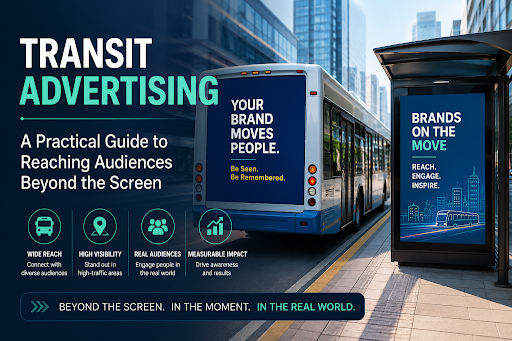
Digital advertising dominates many marketing discussions, but businesses that rely only on online channels often overlook one of the most visible forms of brand exposure: Transit Advertising. Whether people are commuting to work, traveling between cities, or waiting at transportation hubs, transit media provides repeated brand exposure in environments where audiences are naturally attentive to their surroundings.
Unlike many digital ads that disappear after a few seconds, transit advertising becomes part of people's daily routines. A branded bus, taxi, train, or station display can generate thousands of impressions every day from commuters, pedestrians, and drivers alike. Understanding how this advertising channel works allows businesses to build stronger local awareness while complementing their broader marketing strategy.
What Is Transit Advertising?
Transit advertising refers to promotional messages displayed on or inside transportation vehicles and related infrastructure. These advertisements can appear on buses, trains, taxis, ride-sharing vehicles, subways, airport shuttles, station platforms, and transit shelters.
The primary advantage of transit advertising is mobility. Instead of waiting for consumers to visit a website or browse social media, the advertisement travels through different neighborhoods, business districts, shopping areas, and residential communities throughout the day.
Common transit advertising formats include:
- Full vehicle wraps
- Partial vehicle graphics
- Interior transit posters
- Bus shelter displays
- Train station advertising
- Airport transit signage
- Digital screens inside transit terminals
Each format serves different campaign objectives depending on budget, geographic coverage, and target audience.
Building an Effective Transit Advertising Strategy
Successful transit advertising requires more than placing a logo on a vehicle. Careful planning significantly improves campaign performance.
1. Define Your Campaign Goal
Start by identifying exactly what you want to accomplish.
Common objectives include:
- Increasing local brand awareness
- Promoting a new product launch
- Announcing a grand opening
- Driving event attendance
- Supporting seasonal promotions
- Reinforcing existing digital campaigns
A clear objective influences every creative and placement decision.
2. Understand Your Audience
Different transit routes attract different demographics.
For example:
- Downtown business routes often reach professionals.
- University routes primarily reach students.
- Airport transportation targets travelers and business executives.
- Residential commuter routes provide consistent exposure to local families.
Choosing routes that match your audience improves advertising efficiency without increasing budget.
3. Keep the Message Simple
People usually view transit advertisements while moving or from a distance.
An effective design typically includes:
- One primary message
- Large readable typography
- Strong brand colors
- Minimal text
- Clear call-to-action
- Easy-to-recognize logo
If someone cannot understand the advertisement within three to five seconds, the design is probably too complicated.
4. Focus on High-Frequency Exposure
Marketing research consistently shows that repeated exposure improves brand recall.
Transit advertising naturally creates repetition because commuters often travel the same routes every day. Someone may see the same branded bus multiple times each week, making the message more memorable than a single online advertisement.
Practical Examples of Transit Advertising
Different industries benefit from transit campaigns in different ways.
Retail Businesses
A local furniture store may advertise on buses serving residential neighborhoods where homeowners are more likely to shop for household products.
Healthcare Providers
Medical clinics frequently use transit advertising to increase awareness among nearby communities, especially when opening new locations.
Educational Institutions
Universities often advertise enrollment periods using bus shelters and train stations located near city centers where prospective students commute daily.
Restaurants
Restaurant chains commonly promote limited-time menu items using buses traveling through commercial districts with heavy lunchtime traffic.
These examples demonstrate that transit advertising works best when the location matches the audience's daily movement patterns.
Common Challenges Businesses Face
Although transit advertising offers significant advantages, several mistakes reduce campaign effectiveness.
Overloading the Design
Many advertisers attempt to include excessive information.
Avoid:
- Long paragraphs
- Small fonts
- Multiple offers
- Too many images
A clean design consistently performs better than a crowded layout.
Ignoring Route Selection
Not every transportation route reaches your ideal customer.
Advertising a luxury service on routes that primarily serve unrelated demographics often leads to wasted impressions.
Measuring Only Immediate Sales
Transit advertising is primarily a brand awareness channel.
Many consumers may not purchase immediately after seeing an advertisement. Instead, they remember the brand and return later through online searches, direct website visits, or recommendations.
Businesses should therefore measure:
- Brand recall
- Website traffic increases
- Local search growth
- Store visits
- QR code scans
- Campaign reach
Using multiple performance indicators provides a more accurate picture of campaign success.
Expert Tips for Better Transit Advertising Results
Experienced marketers often combine traditional outdoor media with digital marketing rather than treating them as separate strategies.
One effective approach is maintaining consistent branding across every customer touchpoint. The same colors, messaging, and visual identity used in transit advertising should also appear on your website, social media profiles, and email campaigns.
Location also matters more than volume. A smaller campaign placed along highly relevant commuter routes frequently outperforms a larger campaign with poor geographic targeting.
Seasonality can also influence performance. Retail businesses may prioritize shopping districts during holiday seasons, while tourism companies often focus on airport transportation during peak travel months.
Creative testing is another valuable practice. Small adjustments to headlines, color contrast, or calls-to-action can significantly improve audience recall over the duration of a campaign.
Finally, remember that transit advertising rarely works in isolation. It becomes most effective when integrated with search marketing, local SEO, social media, and content marketing. As consumers notice your brand offline, many will search for it online before making a purchasing decision.
To support that journey, businesses should regularly evaluate how their websites perform after offline campaigns launch. Tools such as AudEsto can help identify technical SEO issues, generate white-label audit reports, and ensure landing pages provide a strong experience for visitors who discover your brand through transit advertising.
Conclusion
Transit advertising remains one of the most effective ways to achieve broad local visibility while reinforcing brand recognition through repeated exposure. By selecting the right routes, designing clear creative assets, and integrating offline campaigns with digital marketing efforts, businesses can reach audiences throughout their daily routines without competing for attention in crowded online spaces.
The most successful campaigns prioritize relevance over complexity. A simple message, strategic placement, and consistent branding often deliver stronger long-term results than overly complicated advertisements. When combined with a well-optimized online presence, transit advertising becomes a valuable component of a balanced and sustainable marketing strategy.
Leave a Comment
Loading comments...