Two companies. Same AI tool. Same quarter of deployment. Six months later, one team calls it transformative. The other calls it a glorified search bar.
The difference is not the tool. It is the context layer each team built around it.
This is the story of AI business context refinement in 2026 — and understanding it is the difference between AI that actually moves your business forward and AI that produces confident-sounding answers that are completely wrong for your situation.
What Is AI Business Context Refinement?
AI business context refinement is the deliberate practice of building, curating, and continuously improving the contextual information that shapes how AI understands and responds to your specific work.
In plain language: out-of-the-box AI knows a lot about the world in general. It knows very little about your business specifically — your pricing logic, your customer policies, your internal terminology, your approval workflows, your escalation paths. Without that information, the AI guesses. And guessing at scale is expensive.
Business context is the operational knowledge your AI system needs to answer correctly, take the right action, and avoid unsafe assumptions. For AI applications, that context might include product rules, support policies, account data, pricing logic, workflow steps, escalation paths, internal terminology, and examples of good responses.
Context refinement is the process of systematically feeding that operational knowledge into your AI systems so they stop guessing and start knowing.
The Performance Gap Is Massive
This is not a minor quality improvement. The numbers are striking.
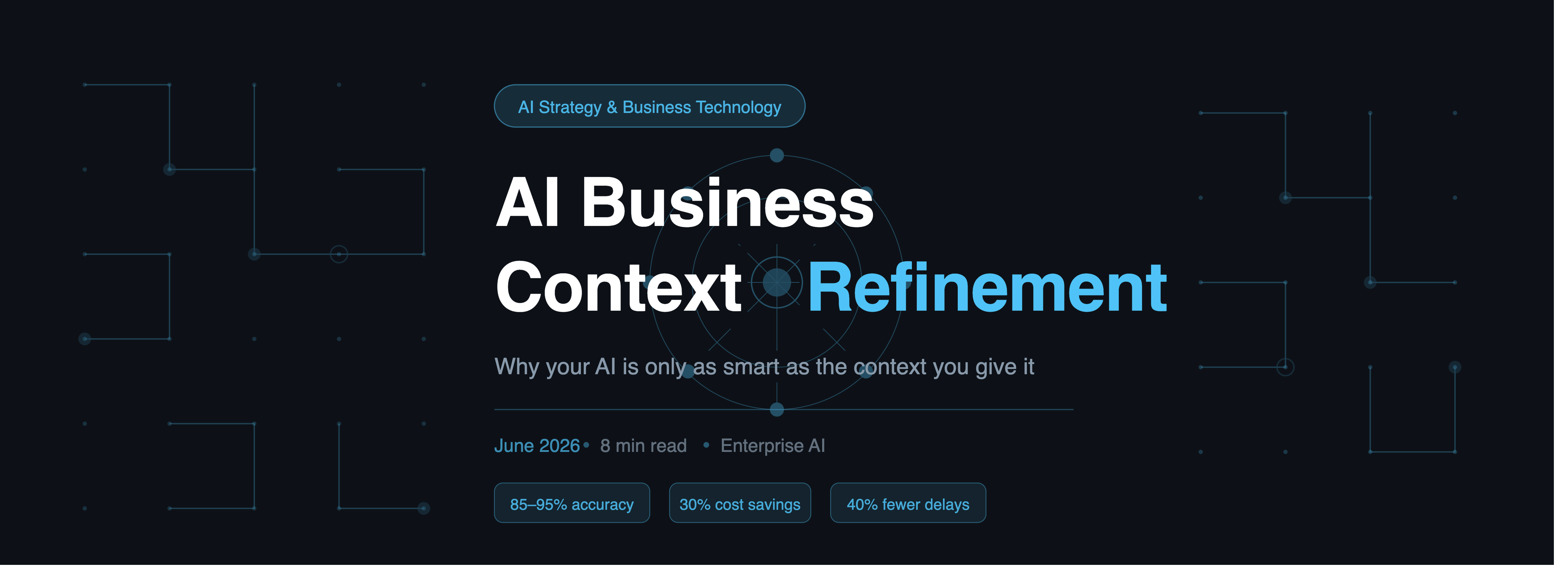
While off-the-shelf AI might achieve 60% accuracy on your tasks, properly refined contextual AI can reach 85–95% — the difference between disappointing results and real business value.
That gap — 60% versus 90% — is the difference between a tool your team stops using after three weeks and one that becomes genuinely indispensable. It is also the gap that separates businesses winning with AI from those still waiting for it to deliver the ROI their vendors promised.
There is a specific failure pattern that keeps appearing in enterprise AI deployments. The model is powerful enough. The data exists. The team is motivated. But results are flat. As one industry report captured it directly: "2026 tools are working with 1990s context." That is not a model problem. It is a context problem.
A Gartner study found that organizations using AI only for reporting and automation still experience decision delays of up to 40% because insights lack continuity and business context. The data exists, but the understanding does not flow.
What Business Context Actually Includes
Most people think context means the prompt you write before asking a question. It is much broader than that.
AI business context refinement is a methodology that enhances AI performance by incorporating domain-specific knowledge, operational context, and business objectives into AI models.
In practice, this includes:
Company Knowledge — Product documentation, service descriptions, pricing structures, terms and conditions, internal FAQs, and brand voice guidelines. This is the baseline that prevents your AI from making up answers about your own products.
Operational Rules — Workflow logic, approval hierarchies, escalation triggers, compliance requirements, and decision-making frameworks. Without these, AI makes decisions that violate your own processes.
Customer Data — Account histories, purchase records, support ticket logs, and behavioral signals. This is what transforms generic responses into genuinely personalized interactions.
Industry Terminology — Every industry has its own language. A legal firm, a construction company, and a SaaS startup all use words differently. Context refinement teaches your AI to speak your language, not a generic approximation of it.
Feedback Signals — Every corrected response, every flagged output, every user rating is information. Every interaction — whether it is a corrected response, a user rating, or a system flag — can be used to fine-tune how the AI interprets context. Over time, these signals help the system learn what "good" looks like in your organization.
How Context Refinement Works in Practice
There are several technical approaches businesses use, and understanding them helps you choose the right one for your situation.
Retrieval-Augmented Generation (RAG) is currently the most widely adopted method. Instead of baking all your business knowledge into a model through expensive fine-tuning, RAG pulls the most relevant information from your knowledge base at the moment a query is made and feeds it into the AI's context window. RAG helps reduce hallucinations, ensures responses are based on approved data sources, and makes it easier to audit where information came from.
Prompt Engineering with Business Rules involves building structured system prompts that contain your operational constraints, tone guidelines, and decision rules. It is the fastest way to start and works well for focused use cases like customer support or sales assistance.
Fine-Tuning involves retraining a model on your specific business data. It produces the most deeply embedded business knowledge but is expensive, time-consuming, and requires significant technical resources. Most mid-sized businesses are better served by RAG combined with strong prompt engineering before considering fine-tuning.
Continuous Feedback Loops keep the context current. While core models may not retrain instantly, modern AI systems can adapt by updating prompts, retrieval sources, and memory layers. Building feedback mechanisms into your AI tools from day one is one of the highest-leverage decisions you can make.
Real-World Applications
Context-refined AI is already delivering measurable results across business functions:
Customer Support — When a support AI knows your return policy, your product specifications, your pricing tiers, and your customer's actual order history, it resolves issues correctly on the first interaction instead of producing plausible-sounding answers that send customers in the wrong direction.
Sales Assistance — AI that understands your ICP (ideal customer profile), your competitive positioning, and your pricing logic can qualify leads, draft proposals, and surface relevant case studies without requiring sales reps to manually verify every output.
Financial Decision-Making — Context-aware AI adds meaning to real-time analytics. It explains what changed, why it matters, and what risks or opportunities may follow. PwC estimates that enterprises combining real-time analytics with contextual AI reduce operational inefficiencies by up to 30 percent.
Compliance and Governance — In regulated industries, context refinement is not optional. AI that operates without an understanding of your regulatory constraints is a liability. Context-refined AI respects governance boundaries while still enabling speed.
Where to Start
Context refinement does not require a massive infrastructure project. Start with the highest-volume, highest-impact use case in your business — typically customer support or internal knowledge retrieval — and build a context layer for that specific workflow.
Document what your AI needs to know to answer that use case correctly. Build a knowledge base. Test against real queries. Measure accuracy. Refine based on failures. Expand from there.
The businesses that will have a sustainable AI advantage in the next three years are not the ones with the biggest AI budgets. They are the ones doing the methodical, unglamorous work of teaching their AI what their business actually means.
That work starts with context.
For practical guides on AI tools, digital platforms, and business technology, visit LetDigitalFly.com and AllFileTools.com.