This guide covers what Adaptive Software Development is, how it connects to the Team Software Process (TSP) and Rational Software Architect (RSA), and how these methodologies work together in modern development teams.
What Is Adaptive Software Development?
Adaptive Software Development (ASD) was created in the mid-1990s by Jim Highsmith and Sam Bayer as an evolution of Rapid Application Development (RAD). Where RAD introduced speed and short iterations, ASD went further — making continuous learning a required phase of every cycle, not just a side effect of working fast.
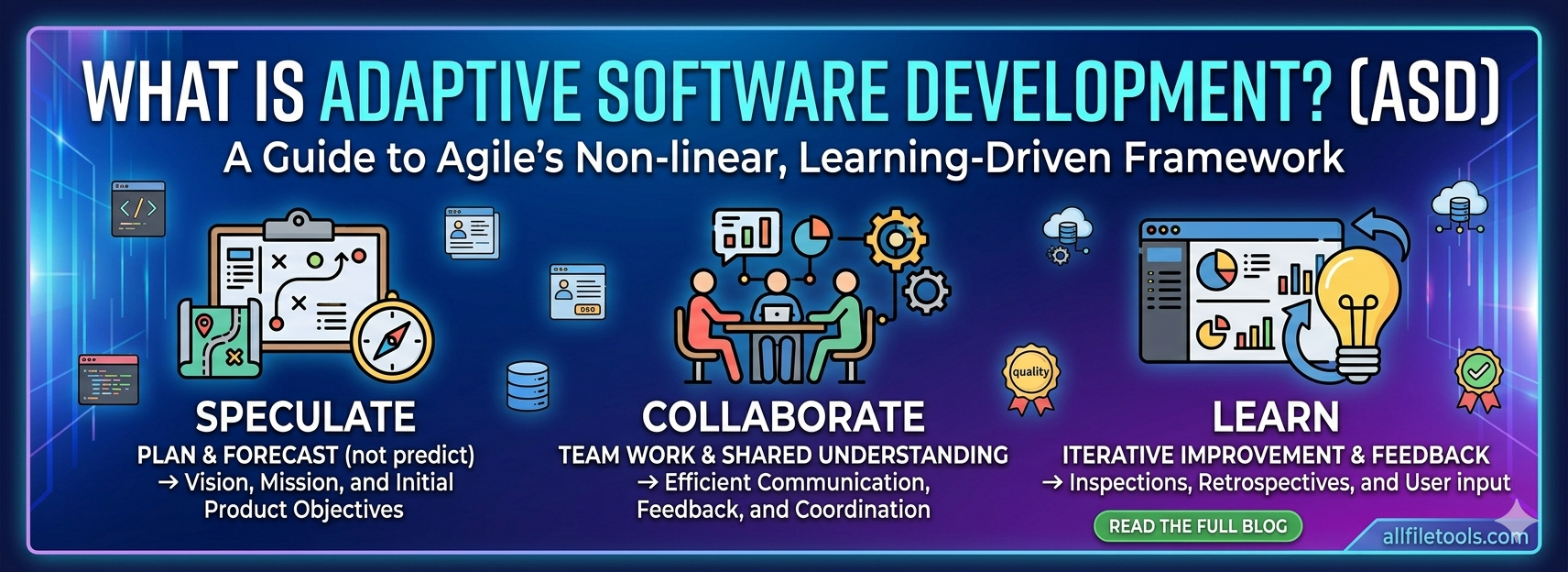
ASD replaces the traditional Plan → Design → Build sequence with three overlapping, repeating phases:
1. Speculate
The word choice here is deliberate. Speculation acknowledges uncertainty from day one. Teams define a mission and rough scope, set time-boxed cycles, and accept upfront that both will evolve. There is no false confidence in a fixed plan.
2. Collaborate
Continuous, documented communication between developers, customers, and stakeholders throughout every cycle — not a weekly status update, but genuine ongoing dialogue about what's being built and whether it solves the right problem.
3. Learn
A mandatory end-of-cycle review where the team examines what they built against expectations, identifies which assumptions proved wrong, and decides what the next iteration should do differently. This is ASD's defining contribution — it separates the methodology from mere fast iteration.
Jim Highsmith went on to co-sign the Agile Manifesto in 2001. ASD's core principles — people over processes, responding to change over following a plan — became foundational to the entire Agile movement.
When Does ASD Work Best?
ASD is most effective on projects with:
- Unclear or rapidly evolving requirements
- High technical uncertainty
- Teams with genuine autonomy to build and iterate
It's less suited to heavily regulated or bureaucratic environments where every decision requires multi-layer approval.
In one sentence: You don't know exactly what you're building when you start — and that's fine, as long as you build a process that gets smarter every cycle.
ASD vs Agile vs Scrum: What's the Difference?
Many developers encounter ASD for the first time and wonder how it differs from Scrum or general Agile practices. Here's a quick comparison:
| Aspect | ASD | Scrum | General Agile |
|---|---|---|---|
| Created | Mid-1990s | 1995 | 2001 (Manifesto) |
| Cycle name | Speculate–Collaborate–Learn | Sprint | Iteration |
| Change handling | Expected from the start | Managed at sprint boundaries | Varies by framework |
| Learning emphasis | Mandatory, structured phase | Retrospective (optional in practice) | Encouraged but informal |
| Best for | High-uncertainty projects | Cross-functional product teams | Broad applicability |
ASD predates the Agile Manifesto and directly influenced it. Scrum and Agile frameworks share ASD's values but differ in how they structure the work.
What Is the Team Software Process (TSP)?
If you're asking what the Team Software Process is and how it relates to adaptive approaches, the answer starts at Carnegie Mellon University's Software Engineering Institute.
Watts Humphrey — widely regarded as the father of software process improvement — developed TSP in the late 1990s to give software teams a disciplined, measurable framework for planning, quality tracking, and execution.
TSP is designed for teams of 2 to 20 members and builds on Humphrey's earlier Personal Software Process (PSP), which focused on individual developer discipline. TSP scales those principles to the team level, establishing self-directed teams that manage their own work, own their quality outcomes, and operate without constant management oversight.
TSP Results
Teams using TSP consistently report:
- 25–40% improvement in productivity
- 60–80% reduction in defects compared to unstructured development
These gains come from rigorous early-stage quality management that catches problems before they reach testing or production — not from working faster, but from working with more discipline from the start.
How ASD and TSP Work Together
ASD and TSP are not in competition. They operate at different levels:
- ASD governs how the project lifecycle responds to change — the big-picture rhythm of speculate, collaborate, and learn.
- TSP governs how the people inside that lifecycle work with discipline — how individuals plan their tasks, track defects, and review each other's work.
Many teams run TSP practices inside an ASD-style iterative structure and get the benefits of both: adaptive flexibility and engineering rigor.
What Is Rational Software Architect?
Understanding Rational Software Architect (RSA) requires thinking about a common gap in software projects: the distance between how software is designed and how it's actually built.
In most projects, architecture lives in someone's head, a whiteboard photo, or a scattered set of diagrams that drift out of sync with the code the moment a sprint begins.
IBM Rational Software Architect is an enterprise-grade UML modeling and design environment built on the Eclipse Modeling Framework (EMF). It supports:
- UML 2.0 diagrams
- Business Process Modeling Notation (BPMN)
- Domain-specific languages
Its most powerful capability is Model-Driven Development (MDD): the architecture model is the source of truth, and code is generated from it. When the design changes, the implementation updates with it — rather than drifting into the gap between what was designed and what was actually built.
RSA integrates with Git and other version control systems, allowing architectural decisions to evolve alongside requirements — exactly the kind of living documentation that ASD's iterative cycles demand.
Do You Need RSA?
RSA is an enterprise tool best suited for:
- Large systems with many interconnected components
- Teams where multiple architects need a shared visual source of truth
- Projects where design decisions need to be formally documented and versioned
Smaller teams working on simpler applications will find lighter tools like draw.io, Miro, or C4 model diagrams sufficient for their architectural documentation needs.
Putting It All Together: ASD, TSP, and RSA in Practice
These three frameworks address different layers of the same problem — how do you build software well when requirements are uncertain, teams are human, and systems are complex?
| Framework | What It Solves | Who Uses It |
|---|---|---|
| ASD | Project lifecycle under uncertainty | Project managers, team leads |
| TSP | Team-level discipline and quality | Developers, engineering managers |
| RSA | Architectural clarity at scale | Architects, senior engineers |
A mature development organization might use all three: ASD to structure how the project evolves, TSP to ensure the engineering team works with discipline inside each cycle, and RSA to maintain a shared, authoritative view of the system's architecture.
Key Takeaways
- Adaptive Software Development is a methodology that treats change as normal, built around Speculate–Collaborate–Learn cycles. It predated and directly influenced Agile.
- The Team Software Process brings measurable engineering discipline to team-level work, with documented productivity and defect-reduction gains.
- Rational Software Architect closes the gap between system design and implementation through model-driven development.
- These three frameworks operate at different levels and can be used together for flexibility, rigor, and clarity simultaneously.
Developer Tools for Every Methodology
Whatever development methodology your team uses, file handling tasks — format conversions, data validation, hash verification, encoding and decoding — add friction to every workflow. AllFileTools.com offers 32 free, browser-based developer tools to eliminate that friction: no account, no installation, no data sent to a server.
Useful tools for development workflows:
- Hash Generator — Verify file integrity with MD5, SHA-1, SHA-256, SHA-512
- Base64 Encoder/Decoder — Handle API payloads and auth headers
- JSON to CSV / CSV to JSON — Convert between data formats in seconds
- UUID Generator — Generate RFC-compliant identifiers for database keys and fixtures