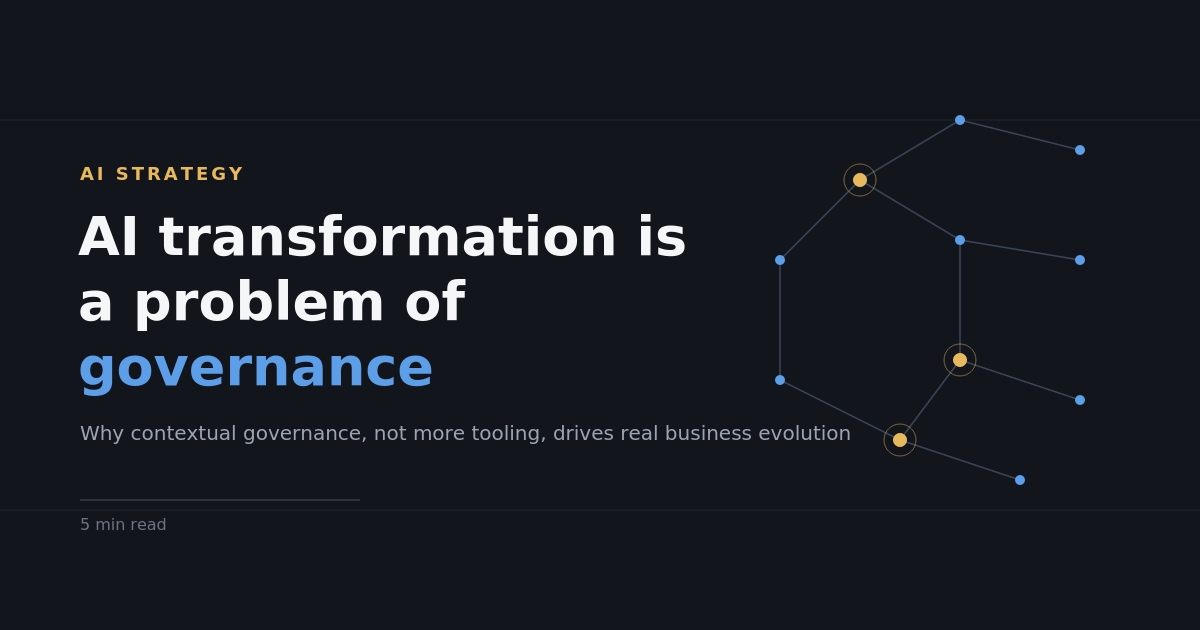
There's a line going around that a lot of people in tech circles have been nodding along to: AI transformation isn't a tech problem, it's a governance problem. Makes sense why it stuck. Plenty of companies bought the software, ran their pilot programs, checked all the boxes — and somehow still feel like nothing real has shifted.
The tooling illusion
Most companies enter their "AI transformation" the same way they entered cloud transformation a decade ago: procure the platform, train a few teams, declare victory in a slide deck. But AI is not a static tool you install once. It is a continuously learning, continuously changing system that touches decisions, data, and accountability all at once. You can buy a copilot for every employee and still have no transformation to show for it, because the bottleneck was never access to the model. It was who gets to decide what the model is allowed to do, on what data, with what oversight, and what happens when it's wrong.
That's a governance question, not a procurement question.
Why governance, specifically
Governance is the operating system for decision rights — who decides, who's accountable, what gets reviewed, and what gets escalated. AI transformation fails without it for three concrete reasons:
1. AI collapses the distance between decision and execution. A human analyst recommending a credit limit change goes through review. An AI system embedded in the workflow can execute the same decision in milliseconds, at scale, across thousands of customers before anyone notices a pattern. Without governance redesigned for this speed, organizations aren't making better decisions faster — they're making ungoverned decisions faster.
2. AI outputs are contextual, not fixed. A model's behavior shifts with data drift, prompt changes, fine-tuning, or simply a new use case bolted onto an old deployment. Traditional governance assumes a system's behavior is fixed once approved. AI needs contextual governance — oversight that adapts to how and where a system is being used, not a one-time sign-off that gets treated as permanent.
3. Accountability doesn't automatically migrate. When a process moves from a person to a model, the legal, regulatory, and reputational accountability doesn't disappear — it has to be explicitly reassigned. Most transformation programs never do this work, which is why so many AI initiatives stall at the pilot stage: nobody wants to own the risk of scaling something without a clear line of responsibility.
What contextual governance actually looks like
Contextual governance isn't more paperwork. It's governance that flexes with the situation instead of applying the same checklist to a chatbot answering FAQs and a model approving loans. In practice, this tends to include:
- Tiered oversight based on the stakes of a decision — light-touch review for low-risk, reversible actions; human-in-the-loop for high-stakes or hard-to-reverse ones.
- Living documentation of what a system is allowed to do, updated as its scope changes, not archived after initial approval.
- Clear ownership chains so that when something goes wrong, there's an identifiable person accountable — not a committee everyone assumes covered it.
- Feedback loops that route real-world outcomes back to the people who can adjust the system, rather than treating deployment as the finish line.
This is why the framing matters. A company that treats AI adoption as buying licenses will hit a ceiling fast. A company that treats it as redesigning how decisions get made, reviewed, and owned will actually change how it operates — which is the entire point of "transformation" in the first place.
Business evolution, not a project
The organizations getting real value from AI aren't running a project with a start and end date. They're running an evolving capability, and evolving capabilities require governance that evolves with them. That means governance committees that meet more than once a quarter, risk frameworks that get revisited as models are retrained, and — critically — leadership that understands AI governance as a strategic function, not a compliance afterthought bolted on by legal at the end.
The tweet that started this conversation was right, but it's worth extending: AI transformation isn't just a governance problem — it's a problem of adaptive governance. The technology will keep changing faster than any static policy can keep up with. The businesses that win won't be the ones with the best model access. They'll be the ones whose governance can evolve at the same pace as the technology itself.
The takeaway
If your AI transformation feels stuck despite real investment in tools and talent, the fix probably isn't a better model. It's a hard look at who owns AI decisions in your organization, how oversight adapts as use cases evolve, and whether accountability was ever actually assigned in the first place. Technology is the easy part. Governance is the transformation.